In oil and gas, an internal audit finding is rarely just a note. It pulls a whole chain behind it: open a quality issue, analyse the root cause, decide corrective and preventive actions, revise the work instruction, retrain the people who follow it, then audit again to show the action worked. Every step has to leave a record, because an auditor will ask.
Most companies run that chain on spreadsheets, email and a few disconnected tools. This article compares two ways to put it on a system: build it entirely on the Mendix low-code platform, or put Siemens Teamcenter Quality at the core and use Mendix for the user-facing and integration layer.
Why oil and gas is under more pressure
Suppliers of equipment and services to oil and gas are usually certified to API Spec Q1. The 10th edition, published on 18 September 2023, widened the scope to design and engineering activities, aligned with ISO 9001:2015, sharpened the risk-based approach, revised supplier evaluation and extended record retention. API says nearly 4,000 facilities worldwide are certified under the API Monogram and APIQR programmes.
Those changes translate into very concrete system requirements. A risk-based approach means the risk level of each finding must be scored and stored. Longer retention means records must outlive the software holding them. Supplier evaluation means quality data has to connect to procurement data.
On how audits are run, Siemens material points to ISO 19011:2018 as the guideline, alongside IATF 16949 and VDA for automotive. The common thread: audits need a plan, a questionnaire and rating rules, and findings must lead to actions with a named owner and a due date.
Sources: API — 10th edition of API Spec Q1 · API Spec Q1 · Siemens — Quality audit management
What the closed loop actually contains
Before comparing tools, agree on scope. A complete loop runs through eight stages, and a break in any one of them costs you the whole loop:
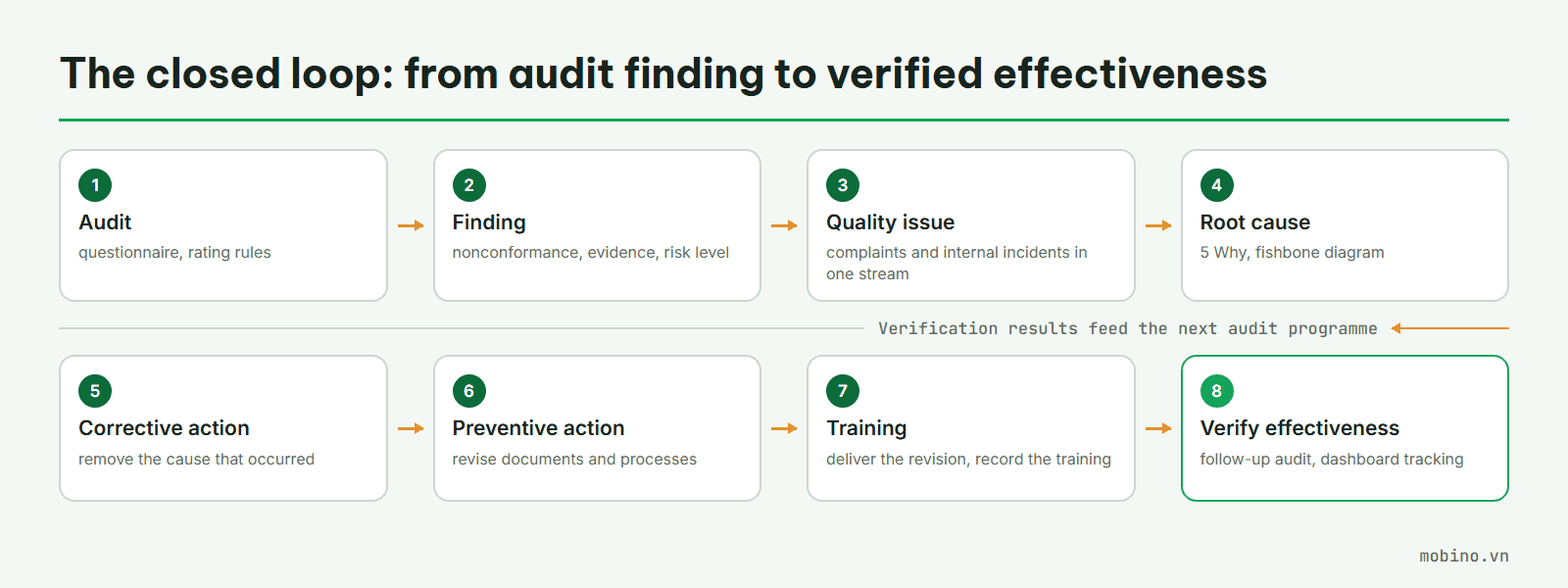
- Plan and perform the audit against a questionnaire, with rating rules for each question and for the audit as a whole.
- Record findings: the nonconformance, its evidence and its risk level.
- Open a quality issue, bringing customer complaints and internal incidents into the same stream.
- Analyse the root cause with 5 Why or a fishbone diagram, recording the reasoning, not just the conclusion.
- Corrective action to remove the cause of the problem that occurred.
- Preventive action to stop the same cause elsewhere, usually by revising documents and processes.
- Training: the revised work instruction must reach the right group, with the training recorded.
- Verify effectiveness with a follow-up audit, and track everything on dashboards.
Stages seven and eight are where most home-grown systems fall short. Producing actions is easy; proving the action reached the people doing the work and actually helped is the part auditors examine.
Option A: build it all on Mendix
This fits when there is no commercial PLM or QMS platform in place, the process has genuinely local characteristics, and running on internal infrastructure is mandatory.
The data model decides everything
All the value comes from records being connected. A minimal but sufficient model covers: the audit programme and individual audits; checklist templates with chapters, questions and rating rules; answers with evidence; findings; quality issues; root cause records; actions and their owners; documents and revisions; training assignments and competencies; effectiveness checks.
Two rules are worth keeping from day one. First, separate the checklist template from the audit that used it, so editing a template never changes a closed record. Second, records become immutable once approved; changes create a new revision. That is what makes records hold up in an audit, and it is very hard to retrofit.
What the platform gives you
- Mendix workflows model the CAPA process with multi-step approvals, role-based assignment and per-step deadlines.
- Scheduled events send reminders and escalate overdue actions, with no extra service needed.
- Security is declared by role and by module, so "who can see what" is answered by configuration rather than code.
- Offline mobile apps for field audits: data is captured on the device and synchronised later. Note that the default synchronisation is last-write-wins, so records edited by several people need explicit conflict handling.
- Dashboards and reports are built directly on the data; no separate BI tool is needed just to track status and due dates.
Sources: Mendix — Offline-first data
What you have to build yourself
The platform does not ship quality domain content. The delivery team builds the question libraries per standard, the rating rules, the 5 Why and fishbone forms, the competency matrix, document revision control, the change log that auditors read, and electronic signatures where regulations require them.
That is not a reason to rule the option out. In the centralised approval system for TH Group, department-specific approval flows, several digital signing methods and a complete audit log were all built on Mendix. But be clear-eyed: choosing this option means owning the lifecycle of the domain logic too, including updates when the standard changes.
Option B: Teamcenter Quality at the core, Mendix around it
Siemens positions Teamcenter Quality as a closed-loop approach "from design to manufacturing to shop floor and back". It ships with the building blocks option A has to construct: audits and questionnaires with rating rules, 8D problem solving, quality action management, FMEA, control and inspection planning, and the ability to capture complaints from internal and external sources.
Its real strength is not the feature list but that quality data connects to engineering data. Siemens Gamesa described exactly that motivation when implementing FMEA and control plans for APQP requirements in wind projects: the goal was to bring the engineering and quality teams onto one platform instead of each keeping their own files.
Sources: Siemens — Teamcenter Quality & compliance · Siemens — Siemens Gamesa
So where does Mendix fit here
This is the part usually misread as "pick one or the other". The opposite is true. In Robert Bosch's One8D project, Teamcenter Quality handles 8D and problem solving, while Mendix provides the front layer and the integrations: connecting customer portals so complaints flow in automatically, plus apps for registering claims quickly. Bosch's project lead states plainly that every interface in the project was built with Mendix. The planned rollout covers 140 locations.
Technically, Mendix ships a Teamcenter Connector to read and write Teamcenter data, and a Teamcenter Extension that generates domain models and microflows for common integration cases. The minimum Teamcenter version is 2406, and 2506 for Teamcenter X. From Mendix 11.12, Mendix apps can be embedded in Active Workspace, so users do not switch between two interfaces.
Sources: Siemens — Bosch One 8D · Mendix — Teamcenter Connector · Mendix — Teamcenter Extension
Comparing the two, and how to choose
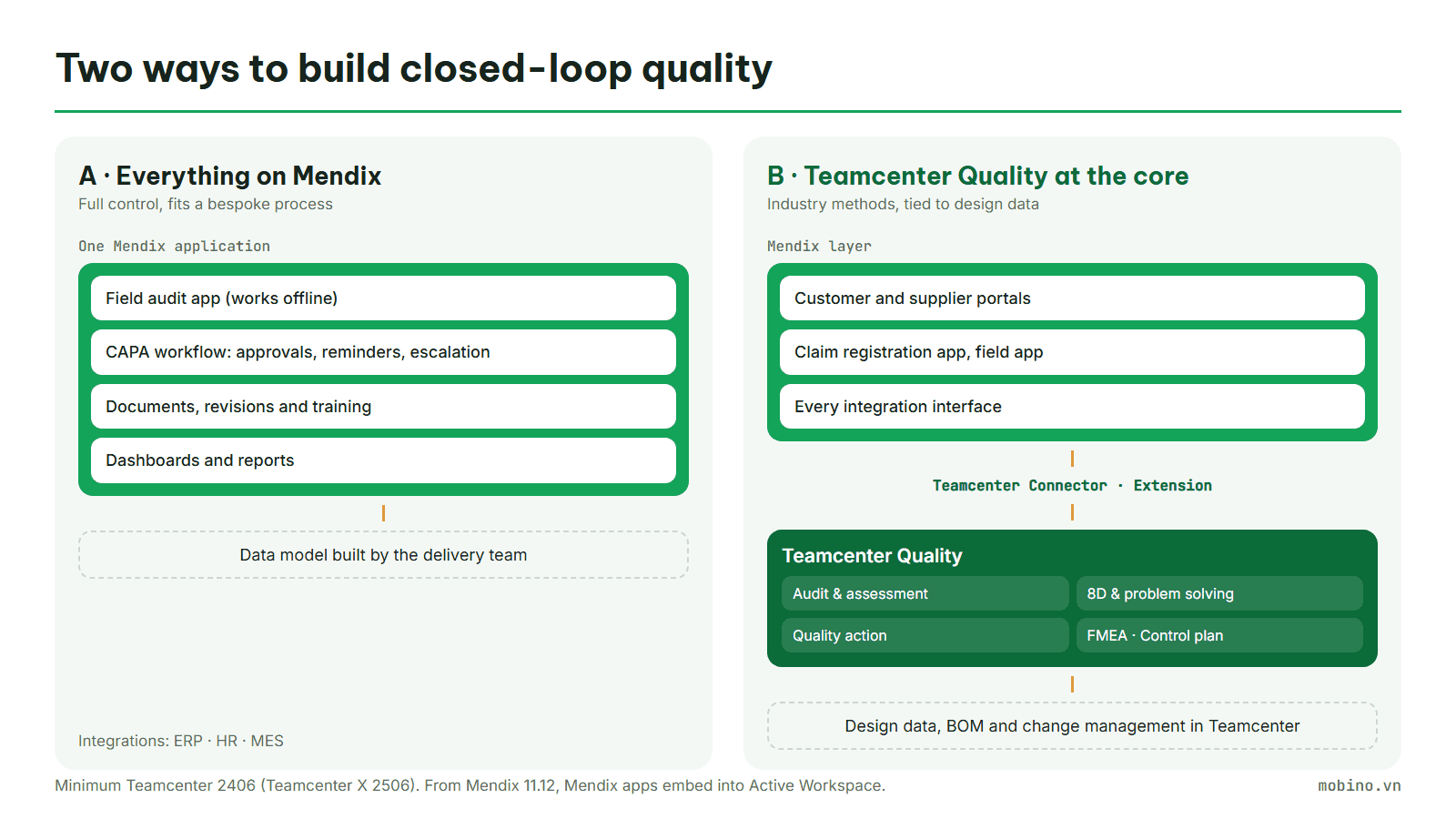
The decision reduces to four questions:
- Does quality data need to connect to design data and the BOM? If so, option B is far cheaper than rebuilding that bridge yourself.
- Does your process follow an industry standard (8D, FMEA, APQP) or is it genuinely your own? Standards point to B; bespoke processes point to A.
- Is the scope one plant or dozens of sites whose data must line up? The more sites, the more a ready-made standardised data model is worth.
- What are the infrastructure and licence constraints? A hard requirement to run internally, on a tight budget, points to A.
There is also a middle path we find reasonable for many companies in Vietnam: start with option A on a narrow scope, but design the data model around the standard concepts — finding, issue, cause, action, effectiveness. If you later move to a commercial core, what you built becomes the front and integration layer rather than wasted work.
A realistic rollout
- Phase 1: one audit type, one plant, running the full loop from audit to effectiveness check. The goal is to prove the loop closes, not to cover every audit type.
- Phase 2: extend the questionnaires and audit types, add the offline field app, bring document control and training into the loop.
- Phase 3: connect the surrounding systems — HR for competency data, procurement for supplier evaluation, MES or operations systems for incident data.
The order matters. Many projects start by digitising the questionnaire and stop there, because the hard part sits at the end of the loop, not the beginning.
Three things that decide the outcome
- A unified data model first, interfaces second. Bosch describes their starting point as fragmented processes with no common data backbone, which left data quality and reporting weak. Many companies in Vietnam are at exactly that point.
- Records must trace every decision: who scored it, when, on what evidence, who approved the action. Adding that after the system is live always costs more than building it in.
- Training belongs inside the loop, not beside it. An action that revises a document without delivering it to the right group simply earns another finding at the next audit.
Conclusion
There is no single right answer. If your quality data has to live alongside design data and you need established industry methods, a commercial core such as Teamcenter Quality is a sound choice — and Mendix still has a clear role in the front and integration layer, exactly as Bosch uses it. If your process is genuinely your own, the scope is contained and the infrastructure must stay in country, building on Mendix gives you a system shaped around how people actually work.
What does not work is a closed loop that exists on paper while the data sits in scattered files. Oil and gas is where the cost of that shows up most clearly, because every audit means proving everything again from scratch.
If you are weighing the two approaches, see how we deliver on our Mendix & Low-code services page.