The week of 12–18 October 2026 brought no major release from Mendix or Microsoft Power Platform. But reading the Siemens sources, the engineering blogs and the Vietnamese market news together, one shift stands out: companies are no longer asking only what AI can do, but what data it uses, which process it runs inside, and how its output gets verified.
Siemens: industrial data needs context before it needs AI
Siemens describes pairing HighByte's industrial DataOps on the shop floor with Intelligence Center X: machine data is cleaned, normalised and given context on Siemens Industrial Edge before it reaches a governed AI environment.
The central argument is that the bottleneck in industrial AI has moved from “being able to connect the data” to “reading the data correctly”. A signal is only worth something once you know which equipment, which line, which production order or which incident it belongs to. Siemens Intelligence Center X, 15 Oct
For Mobino: this is a useful reference model for projects connecting SCADA/PLC, Opcenter, SAP PM and Maximo. AI needs data that already carries context, not just a stream of technical events — the same argument as decisions with a defined type that we wrote about earlier.
Teamcenter: AI in engineering depends on connected data
According to Siemens, the gap between expectation and result for AI in engineering usually lies not in the model but in the quality, accessibility and context of product data. AI placed inside a PLM, engineering and simulation environment can draw on requirements, the BOM, change history, tests and managed quality data. Siemens Teamcenter, 13 Oct
For Mobino: when building applications or agents around Teamcenter, query the authoritative source and preserve versioning, access rights and the relationships between objects.
Food traceability: from compliance to the ability to respond
The post uses the FSMA 204 rule as a starting point to make a different argument: keeping isolated records is not enough to handle a food safety incident. A company has to link raw materials, production lots, lab results, quality, logistics and customers before it can scope the impact quickly and run a targeted recall. Siemens Consumer Products & Retail, 14 Oct
For Mobino: this model fits food and beverage customers and LIMS projects — connecting lab data to batches, warehouses, production and the deviation process.
Mendix: a week without a major release
No major version has appeared since Mendix 11.15. For an engineering team this is a sensible week to test Mendix 11.15, Strict Mode, Maia and the Tools API rather than change the production baseline. Nothing shifts in the Mendix low-code directions we are pursuing.
Meta: the new bottleneck is verification, not code generation
Meta describes how a small team built the Forum app with an AI agent taking part in the whole loop: planning, implementing, building, testing, fixing and verifying. Engineers move from directing each step to setting the goal, watching the run and owning the result.
The most notable part is the measure. Meta does not count success in generated code, but in changes that build, pass automated tests, survive a visual check and get through an engineer's review. The post is also explicit that human-on-the-loop is a target rather than a finished state: some stages still keep an engineer in every iteration. Engineering at Meta, 15 Oct
For Mobino: AI-SDLC has to optimise the verification loop, not just the speed of writing code. An agent should build, test and submit its evidence before a result reaches a reviewer — the principle we built into MaiStudio.
Grab: a new use for operational data, with self-imposed limits
Grab sets out an idea for using aggregated GrabMart data as an additional signal for disease surveillance: grouping over-the-counter products into broad symptom classes and flagging demand that departs from a seasonal baseline.
The part worth reading is the limits Grab places on itself. Aggregate counts only, no identity linkage, no individual health inference, no using a single order to classify a customer. Grab also states plainly that this is an early-stage concept rather than a deployed system, and that retail data cannot replace clinical surveillance. Grab Tech Blog, 13 Oct
For Mobino: when operational data is turned to a new AI purpose, define the scope of use, the level of aggregation, who is accountable for explaining it and how it will be checked against an independent source — before you start.
Vietnam: the gap is in incident response, not in tooling
Cisco's Relentless Defense 2026 report, a survey of 8,000 security professionals across 30 markets run in April and May 2026, carries some striking numbers for Vietnam: 95% of organisations surveyed had at least one cybersecurity incident affecting operations in the past 12 months, above the global 91%; only 50% are fully confident they could detect and respond when an AI system is compromised; and 45% of security professionals spend more time collecting and correlating scattered data than handling threats directly. VietnamPlus · Tạp chí Công Thương
For Mobino: agent security does not stop at sign-in and user permissions. It needs limits on data and tools, an action log, monitoring, a way to revoke access and an incident response process — the same questions we raised writing about action rules for agents in the enterprise.
IMF: Asia gains, but the shape of employment changes
At the IMF–World Bank annual meetings in Bangkok, IMF Managing Director Kristalina Georgieva said AI infrastructure investment is helping hold global growth near 3%, with Asian economies seeing the clearest benefit. World Bank President Ajay Banga highlighted the opportunity in “small AI” — solutions that do not depend on large language models — for emerging economies. IMF–World Bank meetings, 12 Oct
For Mobino: Vietnam suits AI built into a process, using company data, with measurable ROI, far more than investment in building large foundation models.
Reading the week together
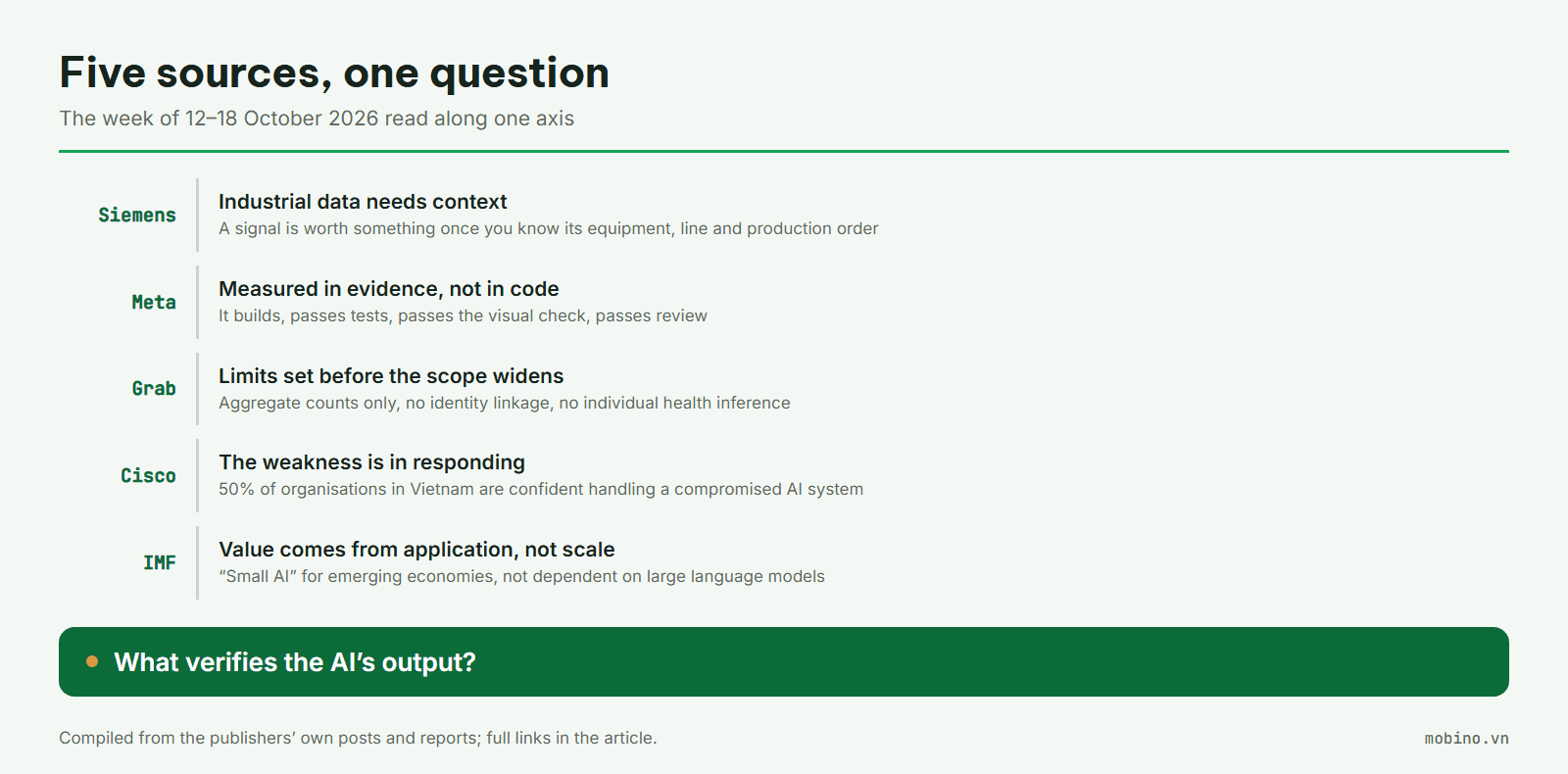
Five different sources, five different industries, one shape. Siemens says AI needs data with context. Meta measures success in evidence rather than lines of code. Grab sets its own limits before widening how it uses data. Cisco shows the weakness sits in the ability to respond. The IMF is a reminder that value comes from application rather than model size.
Enterprise AI is not short of ways to produce output. The hard part is turning that output into a verified result, on the right data, within the right authority, with someone accountable for it. That is exactly the architectural gap that keeps many AI investments from reaching profit. If you are designing flows like these, see our automation and AI page.