For more than two decades, computer science and information technology have usually been read as fairly clear vocational degrees: you study them to become a programmer, a software engineer, a data specialist, a systems administrator or a security specialist. But the speed at which AI is developing raises another possibility: that computer science and information technology are shifting from strongly vocational fields into foundational subjects, much the role that mathematics and computing, or applied mathematics, already play across many disciplines.
The barrier to programming is coming down
The most visible change is in programming itself. Building a software system used to require fluency in a language, a framework, databases, APIs, deployment and a long list of technical tools. Low-code began lowering that barrier, generative AI accelerated it, and agentic AI may take it further still. People are increasingly able to describe a system's goals, requirements and constraints while AI handles much of the detailed implementation.
Which parts of computer science matter more
That does not make computer science less important. It changes which parts of computer science matter. As writing a line of code gets cheaper, understanding systems, data, algorithms, architecture and how to solve problems computationally becomes more valuable, not less.
A future engineer may not need to recall the exact syntax for writing an API, but will still have to understand how that API should be designed, what data passes through it, how access is controlled, how the system behaves when load spikes, and how to verify what the AI produced. AI can write code; handing AI the right problem and judging its output still takes the underlying knowledge.
From a specialist island to cross-disciplinary combinations
This is also why the way we think about studying computer science may change. A computer science student will not necessarily become a programmer, just as someone who studies applied mathematics does not necessarily become a mathematician. Knowledge of computation, data, algorithms and systems applies in finance, manufacturing, logistics, healthcare, biology, energy, construction and business management.
Rather than computer science existing as a specialist island, we may see more and more combinations: finance plus computer science, manufacturing plus computer science, logistics plus computer science, biology plus computer science, business management plus information technology.
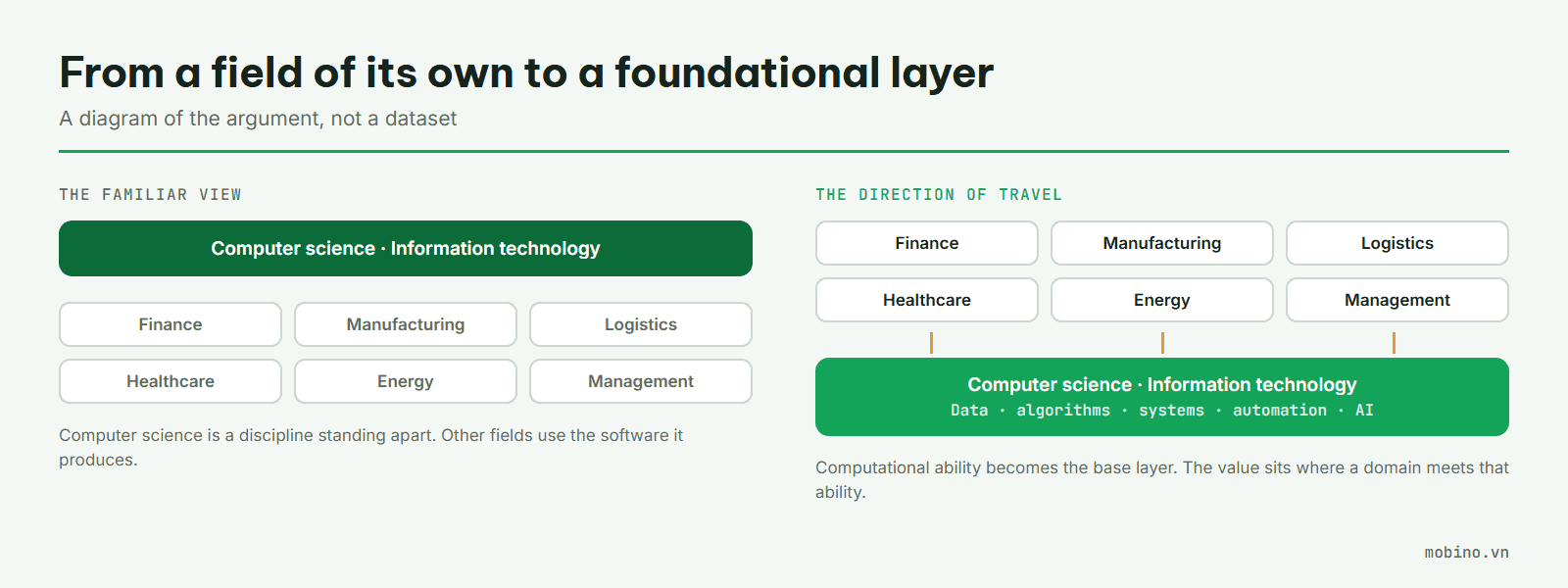
A finance specialist may build their own agents for data analysis and decision support. A manufacturing engineer may work routinely with digital twins, IoT, equipment data and AI. An operations specialist may model a process and then use AI and low-code to build the application that serves their own work. A doctor need not become an AI engineer, but will increasingly need to understand data, probability, the limits of a model and how to assess what it returns.
At that point the real advantage does not necessarily belong to whoever knows the most programming languages, but to those standing at the intersection of domain knowledge and computational ability.
The spreadsheet paradox
A notable paradox follows: the number of people working purely as programmers may fall in relative terms, while the number of people able to create software rises sharply. Something similar happened when spreadsheets became common. Excel did not make finance disappear; it put calculation, modelling and analysis into the hands of hundreds of millions of people who are not software specialists. AI coding may produce the same effect: the ability to build software, long concentrated in IT teams, gradually spreads across other professions.
Which makes the question “will AI replace programmers?” too narrow. The larger question is what happens when using computers and AI to build systems becomes a general skill of knowledge work. If the trend continues, the line between “people who do IT” and “people who use IT” keeps blurring. Business people will not only use software but help create it, while those trained deeply in computer science move up to the harder layer: architecture, algorithms, data, AI, security, optimisation and the design of complex systems.
The path applied mathematics took
In that sense computer science may be travelling a road close to the one applied mathematics took. If mathematics supplies the tools to model the world through structures and relations, computer science adds the ability to model, automate and control the digital world. The further AI develops, the less that ability belongs only to technology professionals, and the more it becomes a foundation for working in many other fields.
Information technology may go through a similar shift, in a more applied direction. Rather than only training the people who build and run IT systems, knowledge of data, digital platforms, automation, integration, information security and AI becomes a layer of capability most organisations need. Just as a manager today has to read a financial statement or use a spreadsheet without becoming an accountant, a manager in future may need to understand data, workflows, APIs, AI agents and automation without becoming a software engineer.
A question for students
This suggests a change in how we think about education too. The question for a computer science student may no longer be mainly “what job will I do when I graduate?” but, more importantly, “in which field will I use computer science to solve problems?” Professional value then rests not on the degree itself but on the ability to combine that foundation with a domain understood deeply enough.
If the forecast holds, AI will not make computer science and information technology disappear. The opposite may happen: they become more universal. Computer science may gradually take on the role of a foundational science, like mathematics and computing or applied mathematics, while information technology becomes a layer of applied capability running through every profession.
The advantage of the next generation may then lie not in knowing more programming than everyone else but in understanding a field deeply enough, and knowing how to use computer science, information technology and AI to solve that field's real problems.